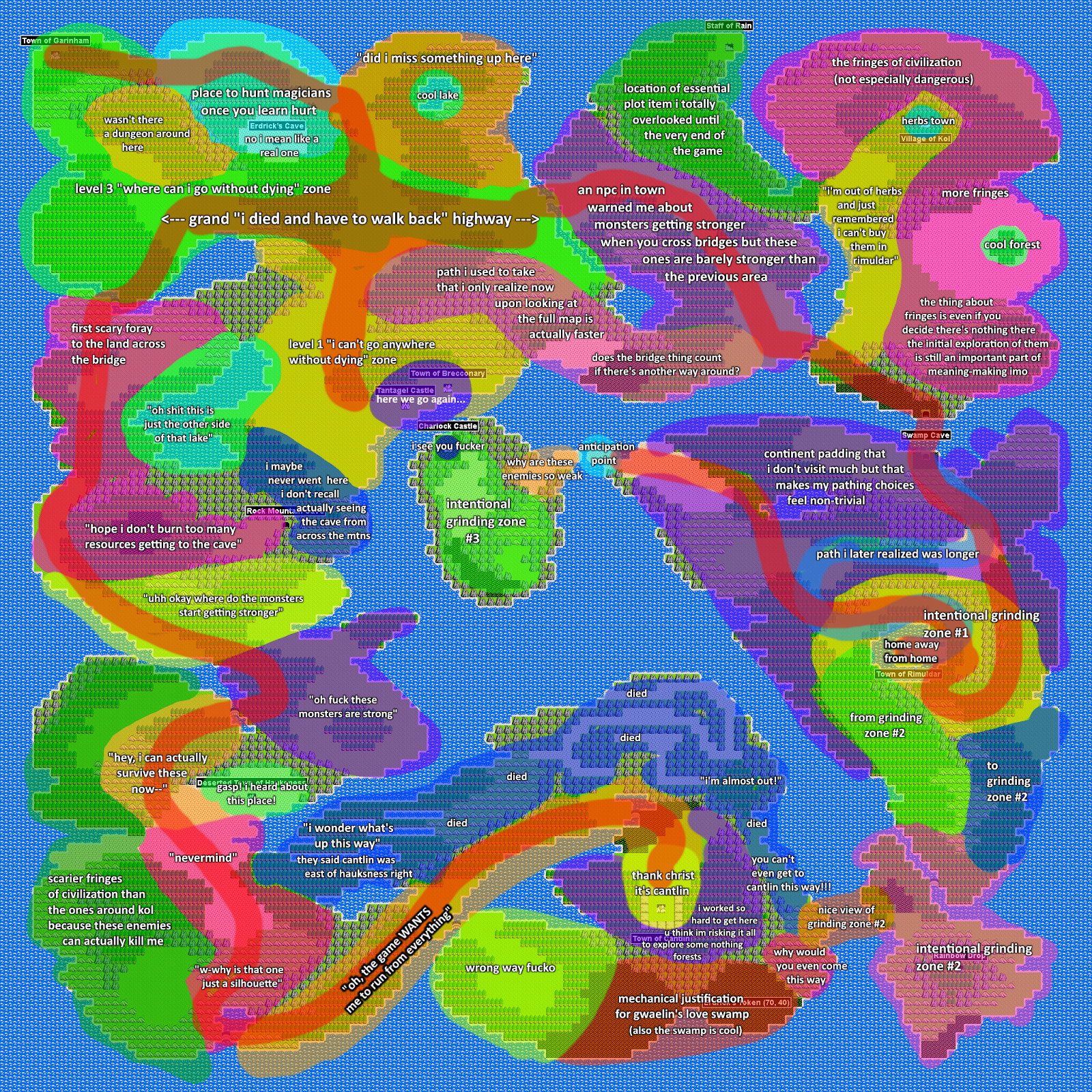
By the time I reached the Sea Cave, I was already accustomed to clearing dungeons across two or three trips. Resources are scarce and safety nets few in Dragon Warrior 2, so dungeon delving was typically a slow, cautious process. I’d stretch my MP and Herbs as far as I could, always hoping to map out just one more hallway so that I could ignore it on my next run. The eternal question was when to decide I had pushed my luck far enough and make my way back to town.

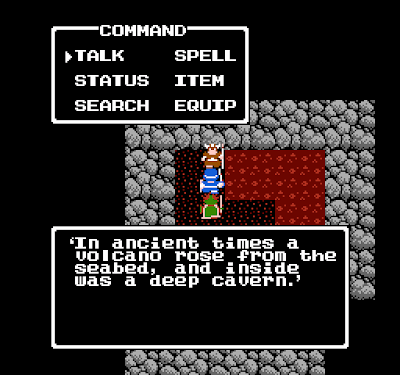
The Sea Cave usually made that call for me. Most of my visits ended in death, when fortune either killed off poor Prince Cannock (his “Outside” spell my quickest and safest means of egress), wiped out my spellcasters’ MP stores with strange jigs, or simply overwhelmed and destroyed my party. The most structurally complex dungeon yet, the Sea Cave’s hidden basement culminated in a non-Euclidean stairway maze with damaging lava floors. All told, it took me six or seven visits to chart the upper corridors, navigate the magmatic labyrinth below, and claim the Eye of Malroth from the heart of the cavern. I died so many times that by my last visit I could barely afford the cost of reviving my dead comrades after wiping out. The next dungeon, the Cave to Rhone, proved only longer, deadlier, and lousier with mazes, dead ends and guessing games.
This part of the game was really hard, but why? What feeling or experience could Dragon Warrior 2 have been trying to effect by ramping up the difficulty so sharply at this late stage of the game? It felt incongruous at first. Until this point DW2, like Dragon Warrior 1 before it, felt refreshingly transparent and clear-thinking with its design language. DW1 employed RPG staples in ways that struck me as eye-openingly purposeful: its world map, its random encounters, experience points and equipment… And DW2 had so far been no less thoughtful. So what purpose could this difficulty spike have been meant to serve?
There’s nothing unusual about an RPG becoming more difficult as it goes. My fear at this unusually steep jump in difficulty is that it’s an accident, the product of thoughtlessness or “outdated” game design sensibility, and that the best (and maybe even intended) solution is to grind. This worry mounted as I embarked on trek after doomed trek into the Cave to Rhone, growing preemptively resentful of what seemed like an inevitable training detour in my near future. Generally speaking, I don’t mind grinding that much (in fact, I unambiguously enjoyed it in DW1). But the threat of having to upset my journey’s pacing and sink my time into reaching an arbitrary power threshold in order to advance made me feel like I had foolishly misjudged the game, which I felt had demonstrated all game long that grinding was not among its expectations of me. Statistical power requirements for progress had virtually always been satisfied in the natural course of exploring the world; if confronted with danger truly beyond my means to resist, I had been able to find somewhere else to go more suitable to my level (my habit in the open-ended “boat part” of the game). But at this late point in the game, all of the boat part’s many quest threads were converging on the singular path of the Sea Cave, and my current power level wasn’t enough to let me fight my way through my problems like I was used to. After I was able, with some persistence (and more frustration), to squeak through the Sea Cave and the Cave to Rhone, I was rewarded with the still deadlier environment of the Rhone region overworld. Was it time to finally face the inevitable and commit my next couple play sessions to grinding out levels for the final dungeon?
Years of playing RPGs have made grinding an instinctual response when I feel underpowered, but I think to indulge that instinct here would have been to misunderstand DW2’s communication, applying genre logic that the game was not actually operating on. Still hoping to see my trust in the game born out (and to escape unnecessary gruntwork), I began to consider: What if I’m just supposed to run from everything? By making dungeons prohibitively long and costly to win every fight in, maybe DW2 was inviting me to stretch my resources further by escaping from combat. That was, after all, how I got through the final sections of the first game. If my hunch was right, I should then have had a chance of beating DW2 at my current levels by avoiding combat as much as possible, making a mad dash for the boss(es) and preserving as much HP and MP as I can along the way. If I could do this, I could consider the game’s communication with me to have been clear and consistent.
This theory wasn’t born of wishfulness alone; there were two observations that led me to believe running might have been the best option.
First, the difficulty of the Sea Cave shifted my cost-benefit calculus in favor of fleeing. Prior to then, my habit had been to fight each battle I encountered, as long as I thought I could win. In the Sea Cave I could no longer afford to maintain this policy. While I could still survive most individual battles, the collective strain on my resources was just too great (even when I was lucky enough to avoid enemies’ strange jigs). Graver still, individual party members would die more frequently and unpredictably than ever before. With very limited means to revive fallen comrades in the field, they tended to stay dead for the duration of the run. With one or two party members dead, the others were not liable to last much longer. When everyone died, in addition to my progress I would lose half my gold, and since this happened frequently my savings evaporated faster than I could recoup them in battle. Before long I went broke - leaving me with nothing to lose. (Note that I had visited every shop in the world by this point; anything I might have wanted to save up for, I had already bought.)
With my party already half dead, I had no hope of making my way deeper in or safely out of the cavern by force, no means to restore my health or teleport out, and less than ever to lose by dying. In these circumstances, the choice to start running from enemies became obvious, giving me a shot of making it a little farther before perishing completely. Surprising me with its high success rate, running quickly became my most relied upon survival tool, ultimately carrying Prince Midenhall through to the heart of the Sea Cave on his own (albeit just barely). Though I would resume my strategy of fighting every battle once I arrived in the Cave to Rhone, the game had given me several incentives to try running, and now I knew that it worked.
Second: shortly after this, Dragon Warrior 2 started telling me not to grind.
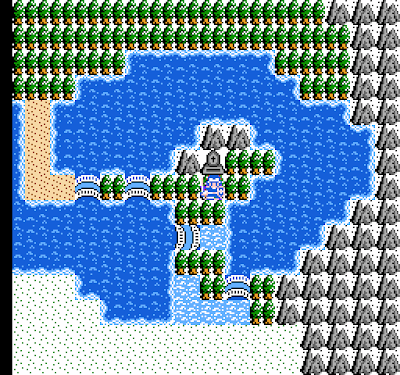
When I finally arrived in the Rhone region overworld, I found it rife with enemies hurling instant death spells at frightening rates. Naturally, I died to them a lot. Even with the local monolith offering free recovery and saving between fights, with death so likely to take one or all of my characters each encounter, grinding seemed like a grim prospect. It’s possible that with some persistence it might have become easier, but with little confidence that higher levels would help me resist instant death, I wasn’t eager to try. And because the game had never asked me to grind before, I was especially hesitant to accept that it was asking me to start now. Instead, noticing that the best way to survive was to spend as little time in combat as possible, I wondered if this wasn’t the latest cue to avoid battle.
What I don’t want to get lost in this description is how much acting on this interpretation felt like an act of trust. I went from being dismayed with Dragon Warrior 2, to suddenly optimistic, and the feeling at the heart of it was “maybe the game is trying to tell me something, and I should listen”. Seeing how far I could progress by running felt less like neutral experimentation than like a sort of give-and-take. “Try it and see,” the game said. “Well, you haven’t steered me wrong yet,” I replied.
And so by fleeing aggressively, I arrived at Hargon’s castle in one piece. I quickly learned that the enemies inside were generally weaker than those on the way to the castle, and less likely to hammer me with death magic. Surprising me further, the part of the dungeon with random encounters was fairly brief: just two or three short floors. The boss battles beyond them, up to and including the two-stage final boss fight, were appropriately hard for endgame boss battles, but with a little persistence each victory was attainable. To be sure, I died many times in the process - maybe a dozen, no more than two. But the several hours I spent throwing myself at the wall of Hargon’s castle felt like a better deal than spending the same amount of time grinding for what would have been a marginal advantage in the same process.
When I finished the game without having made a training detour, it felt like the game was saying “thank you for trusting me.” I felt witnessed and vindicated. It might be silly, but I thought “thank you for honoring that trust”.

So it was possible to finish the game in this way, and whether or not this experience was intended by developers, it arose from what felt to me like an ongoing process of communication with the game. If this experience is my answer to “why was the end of the game so hard?”, then another question arises now: why is this the experience that Dragon Warrior 2 wanted me to have? Even supposing that this experience was an intended one, why would anyone want me to have this one over any other? However unfashionable it is to fixate on authorial intent, I have a personal stake in understanding the motivation for unusual design directions; feeling it could be informative for my own game design practice, the next portion of this essay concerns this question.
My most generous answer is that the endgame’s difficulty had dramatic motivations. On the premise that the end of the game should represent its dramatic climax, there’s cause for difficulty to increase over the course of the game and peak in its final sections. The greatest stakes demand the greatest vulnerability; for this, a qualitative change in the experience of difficulty is more emphatic than a quantitative one. As the game went on, difficulty increased and the survival strategies I adopted early in the game were less and less effective. I squeaked by on thinner margins until finally, in the Sea Cave, those margins shrunk to zero, prompting me to adopt new strategies for the final three dungeons - a qualitative change. I can imagine an alternate version of the game in which the margins of my survival shrank on a different timeline and never reached a zero point; in this version, the final three dungeons are still the hardest part, but if the strategies I’ve been using all game long still work, the vulnerability I take on is pretty minor. What kind of ultimate ordeal is Rhone if I can overcome it the exact same way I have everything else?
If this is DW2’s angle, then its stake in discouraging me from grinding in Rhone becomes clearer: in addition to upsetting the dramatic pacing (particularly since grinding had hitherto been so absent from the rhythm of the game), training to a comfortable level before Hargon’s castle would let me maintain my familiar playstyle, avoid vulnerability, and trick myself into a less pointed dramatic arc.
The request for vulnerability here doesn’t just facilitate a dramatic experience but also serves the game’s vision of heroism. Heroic fantasy has frequently, in my experience, been concerned with the willingness of the hero to overcome situations of great vulnerability. Something important about the strategy of running away, which depends on luck, is that committing to it meant accepting failure, probably multiple failures, as a much more central part of the process than in the strategy of fighting every battle. Running greatly improved my odds in Rhone, but it didn’t guarantee my survival (this is the death magic zone, remember), and it didn’t help me at all when I was fighting the bosses in Hargon’s castle. It was perseverance as much as flight that saw me to the end of the game. The willingness not just to face likely death, but to do so over and over, resolved not to give up until you win despite the odds - that’s heroism! Or at least, that’s the trope. Whatever your own definition, acting out this kind of unshakeable determination certainly paints a more vivid picture of fantasy heroism than toiling for stat gains until you can steamroll the ultimate evil with a stacked deck.
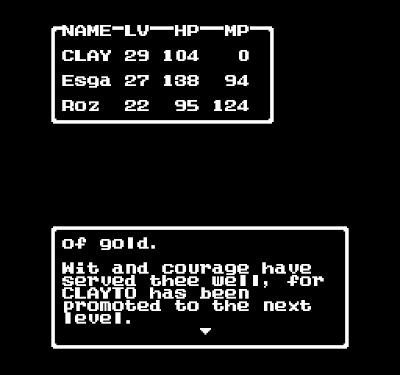
Of course, that's all interpretation. It doesn't prove anything about game's intent, which, despite my speculation, may always be a mystery. This is where I have to admit my limitations: I don't have good language for what I'm trying to do here. I'm not yet comfortable with the language of personal interpretation. Ascribing my own meaning to my experience is one thing, but the sense I need to make is of why the game is like this. It almost isn't even a question of authorial intent, because that only represents the conscious portion of motivation, and there are so many decisions that go into a design process that they can't all be conscious ones. Add to this the chaos of team development and technical limitations and localization (damn it all, the Rhone monolith doesn't even revive you in the Japanese version!) and suddenly the question of intentions starts to feel completely futile. But there's still an object of curiosity underneath all the chaos, and the only way I feel I can get at it is to try to imagine why I might have made the same decisions if I had made the game myself. This is a kind of after-the-fact rationalization that I'm embarrassed to be caught engaging in. (Why am I so desperate for it to all make sense? Can't I just let this old game be a little flawed and inexplicable?) Well, the rationalizations are bound to continue until I can better understand the tension I'm feeling. Even as I'm wrong, I'm learning.